
Cambridge IGCSE
Physics
Master the physical world with CIE's internationally recognised qualification.
🏆 Why APEIRON for Physics?
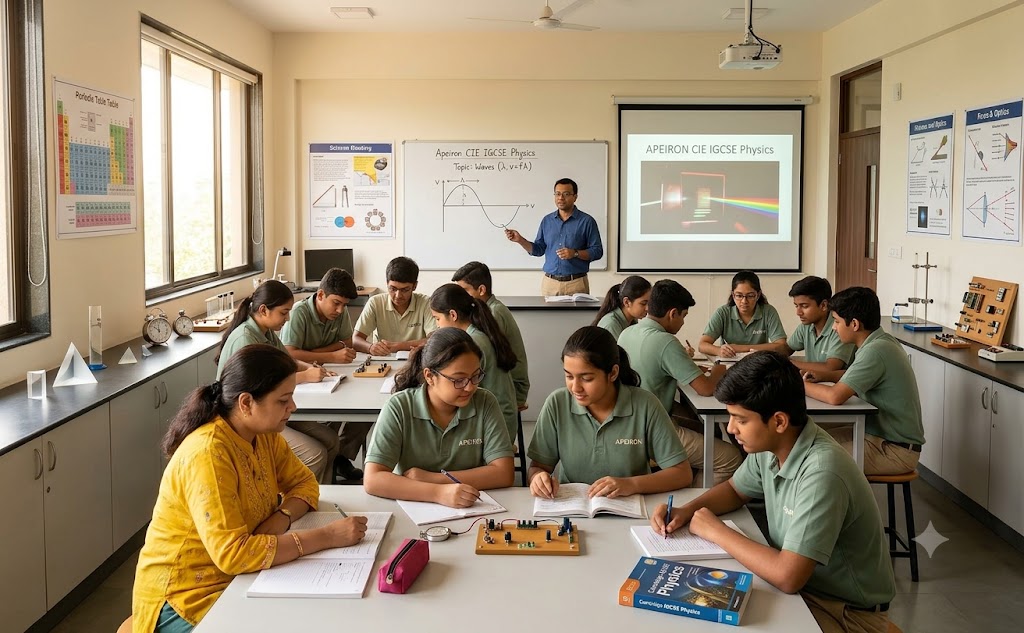
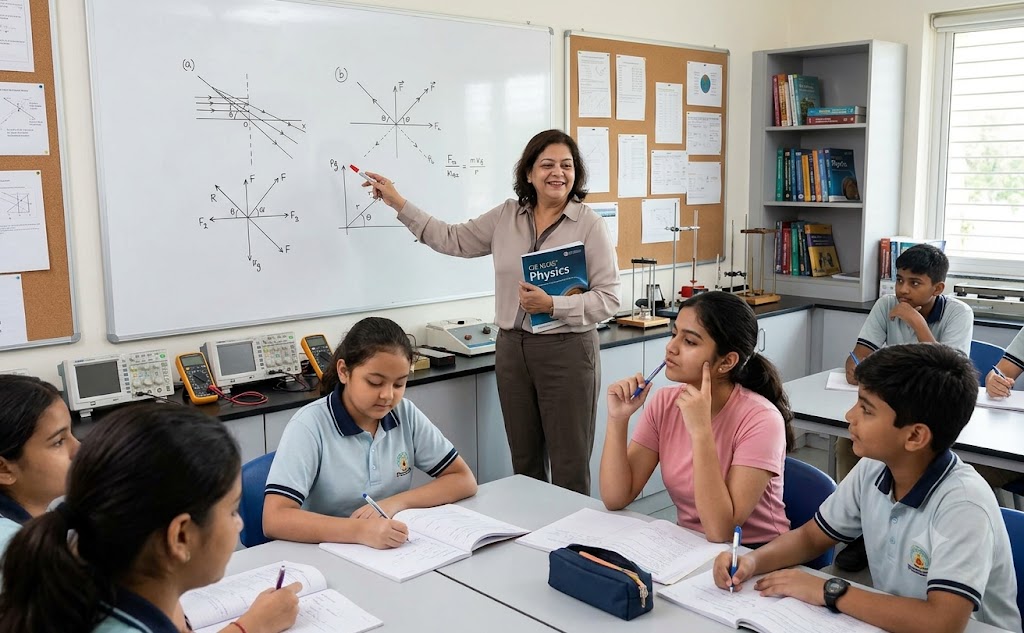
Expert Physics Faculty
Our teachers have 15+ years of CIE and Edexcel Physics experience, guiding students to top grades with proven strategies.
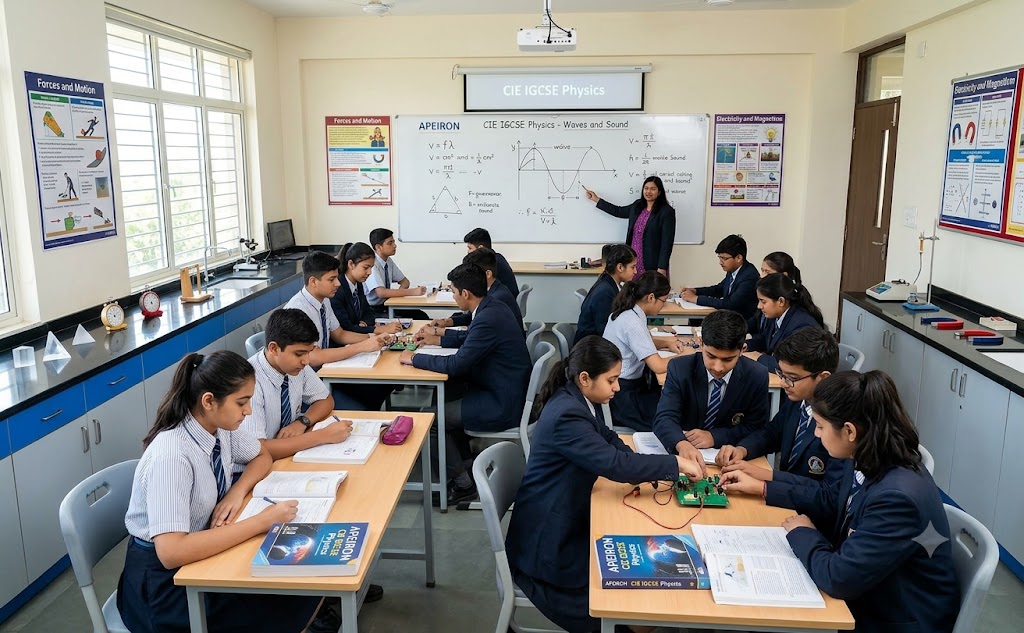
Fully Equipped Lab
Practice all core practicals in our state-of-the-art physics lab. Real apparatus, real experiments – no virtual shortcuts.
Organized Resource System
Our "Chapter Worksheets → Year Questions" system eliminates chaos. Every resource is organized by topic.
Small Batch Size
Maximum 12 students per class. Personalized attention, individual feedback, and tailored support for every student.
| Standard Course | APEIRON Physics |
|---|---|
| ❌ Mixed, unorganized past papers | ✅ Past Papers by Specific Topic |
| ❌ Theory only | ✅ Theory + Physics Lab Room |
| ❌ One worksheet type | ✅ Notes + Worksheets + Exercise + Practice Papers |
| ❌ No past paper structure | ✅ Chapter Worksheets → Year Questions system |
| ❌ Large class sizes | ✅ Small batches (max 12 students) |
| ❌ Limited practical exposure | ✅ All core practicals covered |
📚 Extended Syllabus Content (2026–2028)
Additional topics for Extended tier (Papers 2 & 4) – essential for students targeting A*–B.
🔄 Motion, Forces & Energy
- ➜ Conservation of momentum in collisions
- ➜ Newton's laws of motion in complex systems
- ➜ Gravitational potential energy and kinetic energy in depth
- ➜ Efficiency calculations in energy transfers
🔥 Thermal Physics
- ➜ Specific heat capacity and latent heat calculations
- ➜ Thermal expansion and its applications
- ➜ Kinetic theory in gases and pressure calculations
- ➜ Gas laws (Boyle's, Charles's, and Pressure Law)
🌊 Waves
- ➜ Diffraction and interference of waves
- ➜ The electromagnetic spectrum in detail
- ➜ Sound waves and the Doppler effect
- ➜ Light and reflection/refraction with critical angles
⚡ Electricity & Magnetism
- ➜ Circuit analysis with multiple resistors and bridges
- ➜ Electromagnetic induction and transformers
- ➜ Electric motors and generators
- ➜ Capacitance and charging/discharging curves
☢️ Nuclear Physics
- ➜ Nuclear fission and fusion in depth
- ➜ Half-life calculations and dating techniques
- ➜ Radioactive decay and safety considerations
- ➜ Uses of isotopes in medicine and industry
🪐 Space Physics
- ➜ The Big Bang theory and evidence
- ➜ Orbital motion and gravitational forces
- ➜ Red-shift and the expanding universe
- ➜ Life cycles of stars and stellar evolution
📝 Assessment Structure
📄 Paper 1 – Core Multiple Choice Core
- ⏱️ Duration: 45 minutes
- 📊 Weighting: 20%
- 📚 Content: Core syllabus only
- ✍️ Format: 40 multiple‑choice questions
📄 Paper 2 – Extended Multiple Choice Extended
- ⏱️ Duration: 45 minutes
- 📊 Weighting: 20%
- 📚 Content: Core + Extended syllabus
- ✍️ Format: 40 multiple‑choice questions
📄 Paper 3 – Core Theory Core
- ⏱️ Duration: 1 hour 15 minutes
- 📊 Weighting: 40%
- 📚 Topics: Short‑answer and structured questions
📄 Paper 4 – Extended Theory Extended
- ⏱️ Duration: 1 hour 15 minutes
- 📊 Weighting: 40%
- 📚 Topics: Calculations, explanations, multi‑step problems
🔬 Paper 5 – Practical Test
- ⏱️ Duration: 1 hour 15 minutes
- 📊 Weighting: 20%
- 📚 Format: Hands‑on lab experiment and questions
- ✅ Requires: Lab access, equipment handling
📝 Paper 6 – Alternative to Practical
- ⏱️ Duration: 1 hour
- 📊 Weighting: 20%
- 📚 Format: Written paper on practical skills
- ✅ Suitable for: Students without lab access
⚠️ 2026–2028 Syllabus Update
The latest syllabus (published December 2025) retains the core structure of six main topic areas with minor content refinements:
- 🔄 Motion, Forces & Energy
- 🔥 Thermal Physics
- 🌊 Waves
- ⚡ Electricity & Magnetism
- ☢️ Nuclear Physics
- 🪐 Space Physics
Key changes: New topics include renewable energy systems analysis and introductory quantum physics concepts. Extended tier includes more multi‑step calculations and unfamiliar contexts.
📚 Free Digital Library
Notes, worksheets, and video tutorials – all free for APEIRON students.
📭 Physics resources will be added soon. Check back later!
📝 Past Papers Library
Access official CIE IGCSE Physics (0625) past papers with mark schemes.
📭 Past papers are being uploaded. Please check again later.
❓ Frequently Asked Questions
🌍 Visitor Insights
Real‑time stats powered by APEIRON Visitor Stats Pro
Ready to Master CIE IGCSE Physics?
Join APEIRON’s expert-led classes and get access to our complete digital resource library, past paper practice sessions, and personalised mentorship.
📞 Call us: +8801719014276 | +8801557704046
📧 Email: info@apeironlab.science